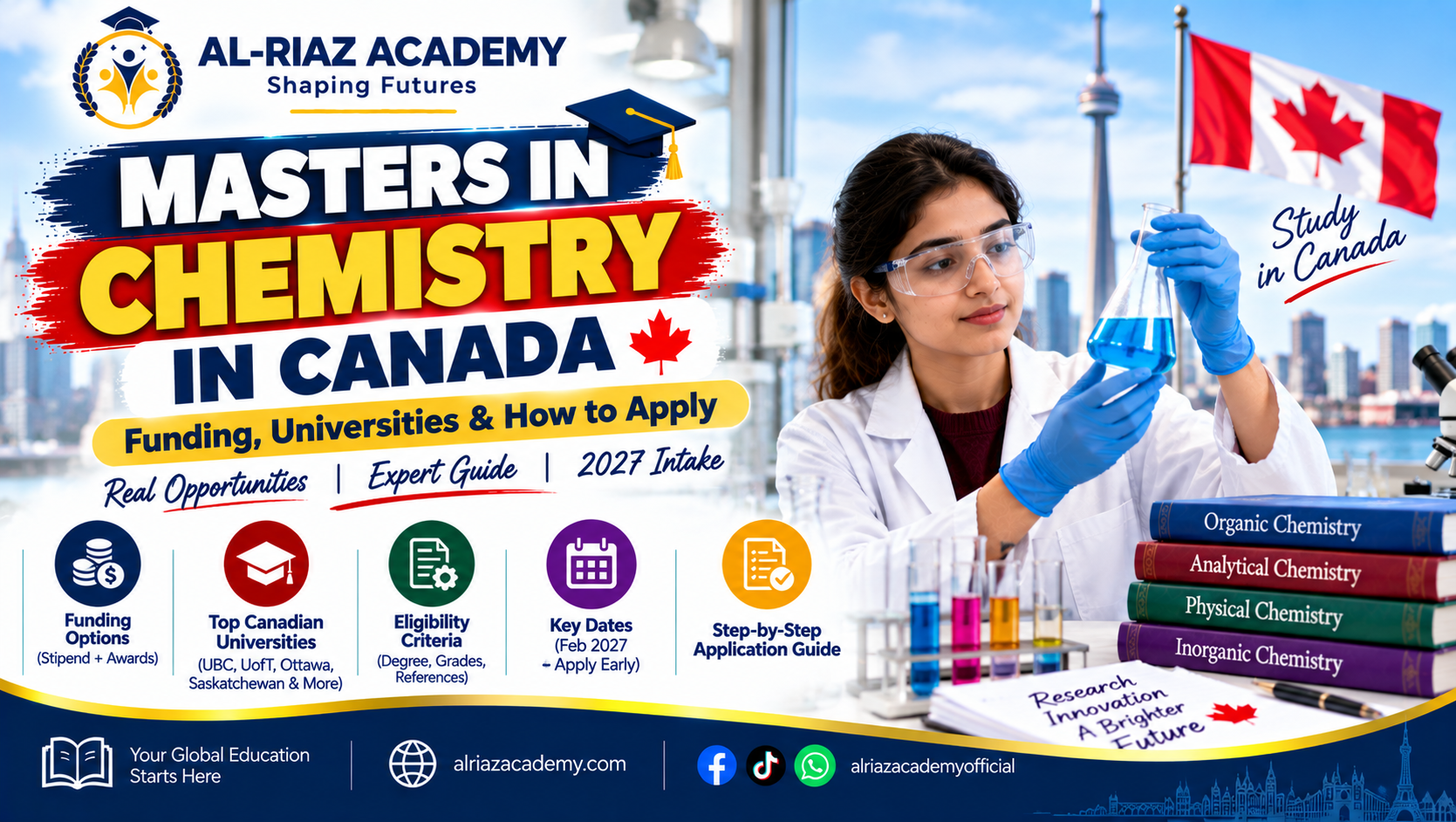
Masters in Chemistry in Canada can be funded, but “fully funded” rarely means every cost is covered. Most research-based programs give a guaranteed minimum package made of stipends, assistantships and awards, and the amount differs by university.
This guide compares reported funding at UBC, Toronto, Ottawa and Saskatchewan. It also explains the main catch for Pakistani applicants: some departments admit very few international Master’s students. For more updates, see our Punjab board news.
Masters in Chemistry in Canada Overview
Canadian chemistry departments offer research-based MSc programs in areas such as analytical, organic, inorganic, physical and materials chemistry. Funding usually combines teaching assistantships, research assistantships and internal awards rather than one named scholarship.
Because of this, the supervisor you work with matters as much as the university. Looking at other fields? See our guide to accounting scholarships in Canada.
Who Can Apply for Masters in Chemistry in Canada?
Requirements differ by university, but common conditions include:
- A four-year bachelor’s degree in Chemistry or a closely related field.
- Strong grades. UBC’s usual minimum is 76% (B+ range), and programs can ask for more.
- References. UBC states that at least three are required for its graduate programs.
- Proof of English proficiency. Required scores vary by program.
Important: UBC Chemistry encourages international applicants to apply directly to its PhD program, because the number of admissions offered to international MSc applicants is very limited.
Funding for Masters in Chemistry in Canada
| University | Reported minimum funding | Notes |
|---|---|---|
| UBC | CAD 27,600 per year on UBC’s official page. ProPakistani reports CAD 30,000 for 2027 | Faculty of Science Master’s Tuition Award equals the domestic tuition fee, for domestic and international students. International Tuition Award up to CAD 3,200 per year if eligible |
| University of Toronto | CAD 30,000 annual take-home stipend plus tuition and incidental fees | Combines assistantships, fellowships and scholarships |
| University of Ottawa | CAD 27,000 per year departmental minimum | Includes scholarships, stipends and teaching opportunities |
| University of Saskatchewan | CAD 26,500 minimum | Stipend from grants, scholarships or teaching assistantships |
| Université Laval | CAD 20,000 “Citizens of the World” scholarship | For international students in a master’s with thesis |
These figures come from university pages and secondary sources, and they can change. Confirm them with each department before you apply.
Even a package of CAD 27,000 to 30,000 must cover living costs, and at UBC international students may still pay part of the tuition. One aggregator lists the University of Regina’s international fee at CAD 29,675 per year, so costs differ widely.
Documents Required
Each department sets its own list, and we could not verify a national one. Commonly requested items include:
- Academic transcripts
- CV
- Statement of purpose
- Reference letters
- English test result
- Passport details
Ask each department for its exact checklist.
Important Dates
| Program | Date |
|---|---|
| UBC MSc Chemistry, September 2027 | February 15, 2027 (reported). UBC’s official page showed July 31 for the 2025 intake, so confirm the current date |
| Toronto, Ottawa, Saskatchewan, Laval | Official notification ka intezar hai. Check each department |
How to Apply for Masters in Chemistry in Canada
- Shortlist universities and check whether they admit international Master’s students.
- Find supervisors whose research matches your interests and email them with your CV.
- Prepare transcripts, references, your statement of purpose and your English test result.
- Apply through the university’s graduate portal. UBC reportedly requires a Campus-Wide Login and an online application.
- Submit everything before the department’s deadline.
- Ask for your funding offer in writing, including the stipend, tuition and duration.
Read UBC’s official MSc Chemistry page for admission and funding details.
Tips for Masters in Chemistry in Canada Applicants
- Contact supervisors early, because many funding packages come from research grants.
- Ask whether the stipend covers tuition or whether you pay it yourself.
- Consider direct PhD entry at UBC if your profile is strong.
- Compare more options in our latest scholarships 2026 hub.
Scam warning: Apply only through official university websites and never pay any fee to anyone who promises a scholarship.
FAQs
Is Masters in Chemistry in Canada fully funded?
Many research programs guarantee a minimum package, but the amount differs and may not cover all your costs.
Can Pakistani students get a Masters in Chemistry in Canada at UBC?
They can apply, but UBC says international MSc places are very limited and encourages direct PhD entry.
What is the deadline?
UBC’s September 2027 deadline is reported as February 15, 2027. Other universities have not been confirmed.
Do I need a supervisor before applying?
Usually it helps, because funding often comes from a supervisor’s research grant.
Final Words
Masters in Chemistry in Canada offers real funding for strong applicants, but the packages and international places vary by university. Compare departments, contact supervisors and confirm every funding detail in writing.
Share this guide with chemistry students planning to study abroad, and we will update this page with Masters in Chemistry in Canada news as universities announce new dates.

Bushra Riaz writes about scholarships and higher education opportunities for Pakistani students at Al-Riaz Academy. She shares clear, step-by-step guides on eligibility, required documents and application processes, and always points students to official websites for the final details.